Mechanically Attached TPO
Screws and plates in the seam laps hold the sheet to steel decks on large open roofs, with tighter rows at corners and edges.

As a Bowling Green TPO roofing contractor, we install white heat-welded membranes on warehouses, retail centers, and offices, attached to suit your deck and the wind your building sees.
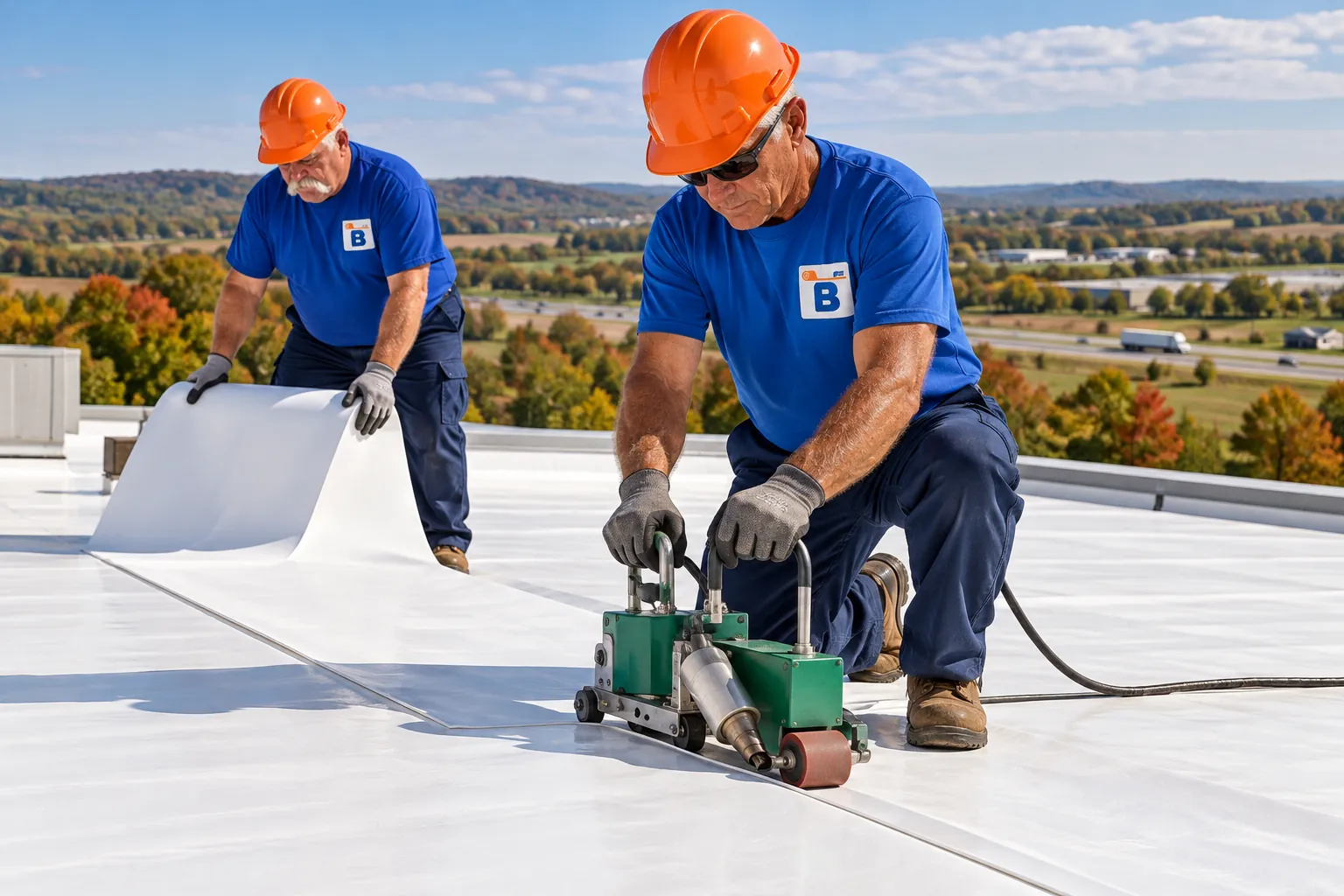
A Bowling Green TPO roofing contractor fits TPO to most low-slope roofs once the deck is firm and the insulation plan is set. These rows show where it fits.
| If Your Roof Shows | New TPO Over Tear-Off | TPO Recover | Look At Another Sheet |
|---|---|---|---|
| A steel deck on a large, open warehouse or distribution roof | Usually Fits | Sometimes | Rarely |
| One dry existing roof layer and a firm deck | Sometimes | Usually Fits | Rarely |
| Heavy rooftop units and long summer cooling hours | Usually Fits | Usually Fits | Rarely |
| Exhaust fans venting grease or oils onto the roof | Sometimes | Sometimes | Usually Fits |
| Wet insulation across large parts of the roof | Usually Fits | Rarely | Rarely |
Near grease or process exhaust, a PVC or KEE sheet holds up better, so we check what the fans vent before choosing.
Older TPO and the roofs it replaces show trouble in predictable places. Here is where each sign turns up.
Roof corners take the highest wind pressure, so a loose perimeter fastening row shows first at the building's corners.
Overflow at a single gutter or scupper often means tapered insulation sends more water there than the outlet can carry.
A dulled white sheet near units and walkways has lost reflectance, and foot traffic there wears the membrane faster.
Leaks that follow a straight line across the ceiling often match a lap with a cold weld or a void.
Curb flashing cut short, or never ended under the counterflashing, lets water run down inside the curb.
A damp deck underside in winter can come from missing vapor control where indoor humidity runs high.
Where three sheets meet, an unpatched T-joint leaves a small channel for water at the step in the lap.
On mechanically attached roofs, a sheet that billows between fastener rows shows wind uplift working the seams.
Water sitting near a drain points to a missing sump or a clamping ring set above the membrane line.
Every TPO job starts with the deck and the attachment method, then the sheet and the details.
Screws and plates in the seam laps hold the sheet to steel decks on large open roofs, with tighter rows at corners and edges.
Bonding adhesive over cover board holds the whole sheet, a fit for high wind exposure and odd roof shapes, scheduled for dry, mild weather.
A loose sheet held by stone or pavers suits structures with load capacity to spare, though the stone hides leak sources later.
A new TPO roof goes over one dry existing layer after a moisture survey, with cover board between and edges raised to match.
Pre-molded boots, welded corners, curb flashing to full height, and walkway pads between the roof hatch and each unit.
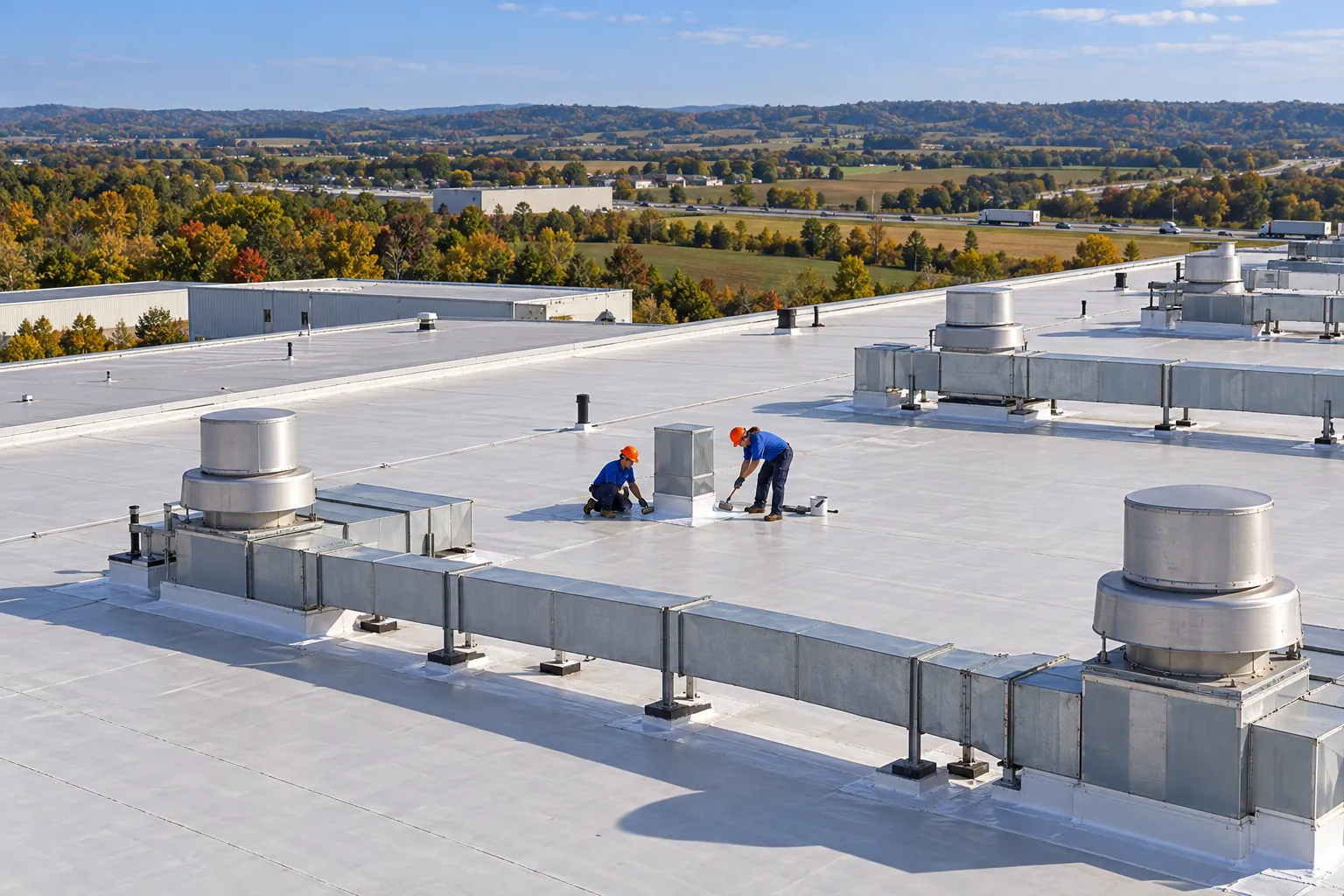
A white welded membrane changes how the roof handles heat, water, and wind. These gains depend on a dry deck and good details.
Hot-air welds fuse the laps, so once they cool the field acts as one membrane with no taped seams to age.
The white roof surface reflects sunlight, which helps buildings with large cooling loads, like warehouses with offices or plants with hot equipment.
Perimeter fastening rows and tested edge metal hold the corners, where wind pressure on a roof runs highest.
Pre-molded boots and welded corners join the flashing to the field sheet with the same hot-air weld as the seams.
Walkway pads from the hatch to each unit keep service traffic off the sheet and the white surface cleaner.
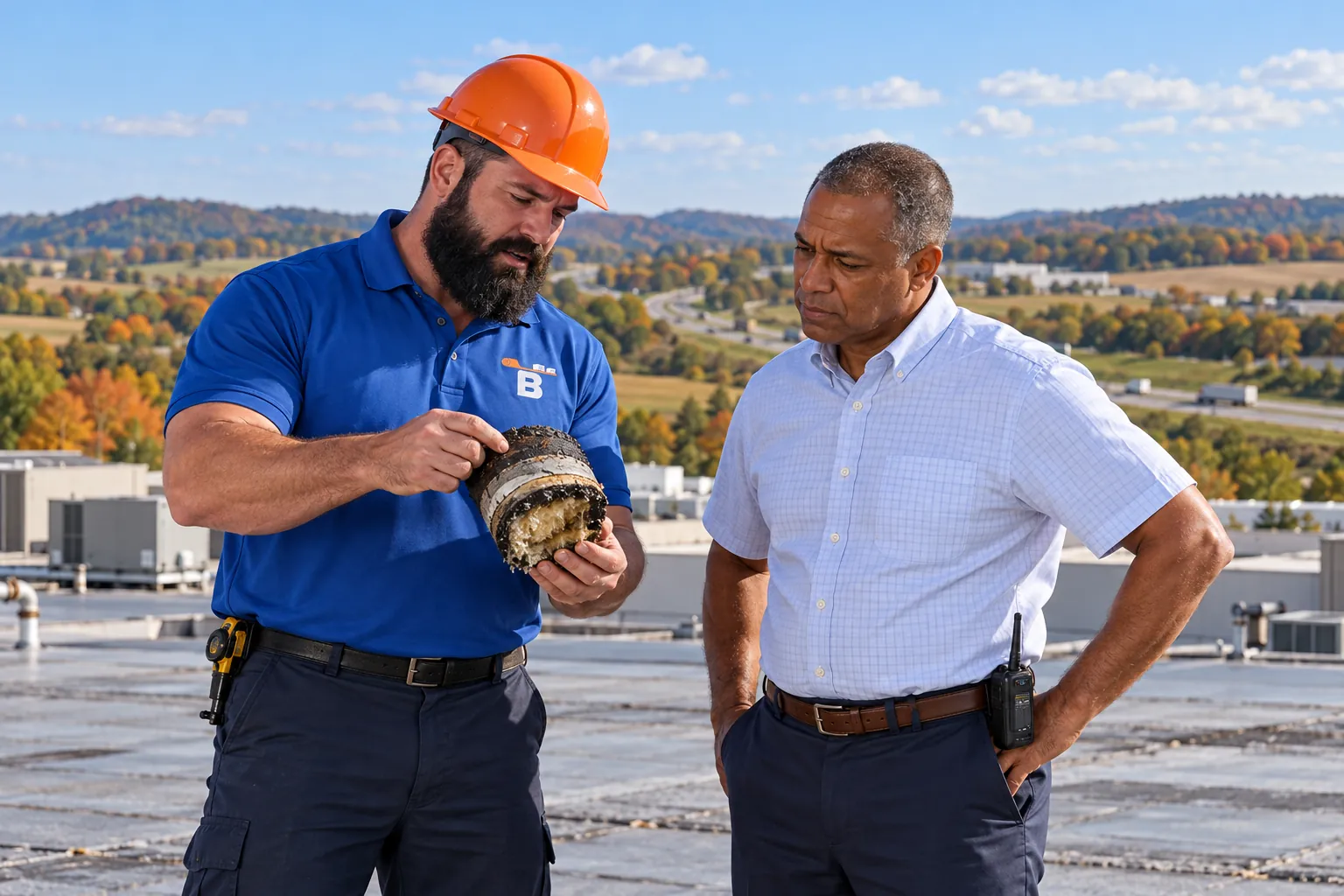
Get a free estimate for your roof, then a roof walk with core cuts to settle attachment, insulation thickness, and the details at every unit.
TPO installation follows the same order on every roof, from the deck survey to the last seam probe.
We walk the roof, cut cores to check layers and insulation, scan for wet areas, and note every curb, pipe, drain, and edge.
Wet boards come out, rusted steel deck is treated or replaced, and new insulation goes down at the thickness the energy code calls for.
Sheets go down by plates and screws, adhesive, or ballast, with extra fasteners or adhesive in corner and perimeter zones.
A robotic welder runs the long laps and a hand welder the details, then every lap is probed and a daily test cut is checked.
Curbs, boots, drains, and edge metal get flashed and fastened, walkway pads go down, and the roof is walked with you.
TPO is one of several sheets we install. These pages cover roofs where another approach fits.
Rubber sheets in large widths mean fewer seams, and EPDM stays pliable when cold-weather work has to go ahead.
EPDM roofing in Bowling GreenPlants venting oils or grease need a membrane chosen for what the fans put on the roof, often PVC or KEE.
Industrial roofing in Bowling GreenOpen welds, cracked boots, and loose curb flashing on a newer sheet get repaired in matching TPO.
Commercial roof repair in Bowling GreenTPO is a single-ply thermoplastic membrane, usually white, rolled over insulation with its seams joined by hot air. It fits low-slope roofs on warehouses, distribution buildings, retail centers, offices, and light manufacturing plants.
Once the welded laps cool, the sheet acts as one piece, and the white face reflects sunlight on buildings with heavy rooftop cooling.
The deck, the wind exposure, and the structure decide it. Mechanical attachment uses screws and plates in the laps and suits steel decks on large open roofs.
Full adhesion bonds the sheet over cover board for high wind exposure and odd shapes. Ballast holds a loose sheet with stone where the structure has load capacity to spare. Corners and edges get extra fastening with every method.
A robotic hot-air welder runs the long laps, and a hand welder handles corners, curbs, and flashing, melting the two sheets together across the lap.
After cooling, every lap is probed for voids or cold spots, and daily test cuts confirm the weld width. Failed spots get a welded cover strip, and T-joints get a patch as routine.
For most commercial buildings, yes. The U.S. Department of Energy's cool roof guide finds that mixed-climate buildings usually gain more in summer than they lose to added winter heating.
Bowling Green has hot summers and cold winters, so the result leans on insulation and rooftop HVAC load. Warehouses with offices and plants with hot equipment gain the most.
Every opening is where the membrane turns a corner, so each gets its own detail. Curbs get TPO flashing up the sides, ended under the unit's counterflashing.
Pipes get pre-molded boots clamped at the top. Drains get a clamping ring over the membrane and a sump cut into the tapered insulation. Walkway pads protect the sheet between the hatch and each unit.
Often, when the old roof is a single dry layer over a firm deck. A moisture survey and core cuts come first, wet areas get cut out, and a cover board goes between the old surface and the new sheet.
Edge metal, curbs, and drains are raised to match, and the building official confirms the layer limit.
Send us the roof size and what sits on it, or call. The first step is a roof walk and core cuts to set the scope.
Want Us To Call You About Your Roof?
Leave a name and number. Prefer to talk now? Call (364) 205-6781.